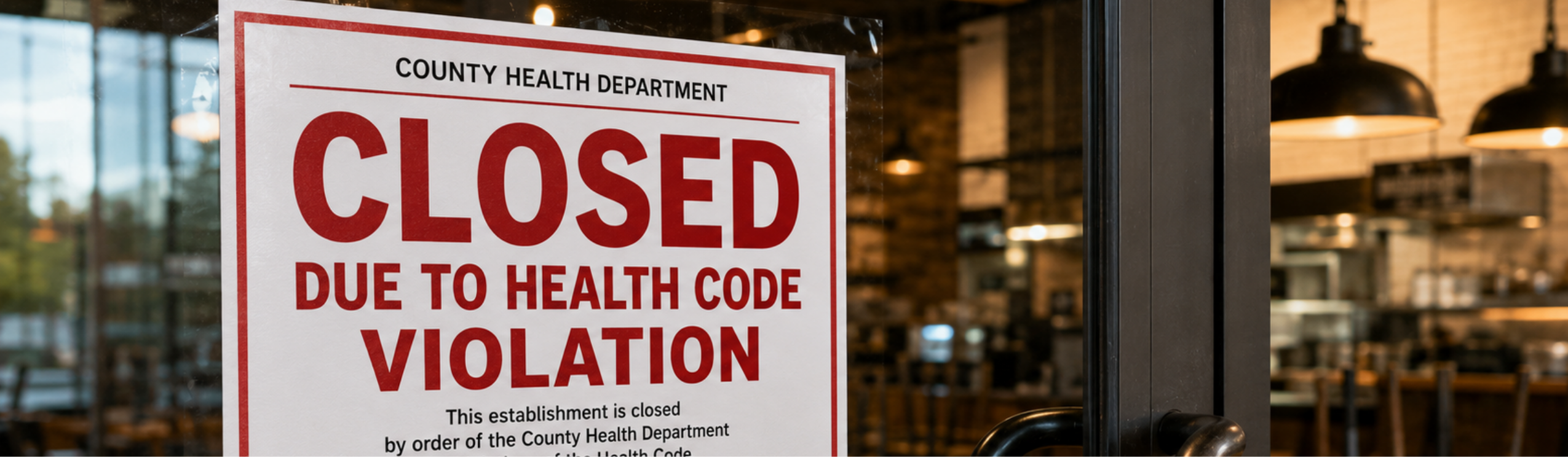
Most operators read the line on a health inspection report – “Fine: $500” – and exhale. That number is the rounding error. The real cost of a failed restaurant health inspection lands over the next 30, 90, and 270 days, in pieces that never show up on the inspector’s paperwork. National Restaurant Association data puts the average critical violation that triggers closure at $45,000 across all segments, $52,000 for full-service restaurants, and $89,000 for healthcare food service. For independents in tourist-heavy markets, severe events routinely cross $150,000.
Here is what is actually inside that number, and what an operator can do about it before the inspector ever shows up.
THE FIVE LAYERS OF A FAILED INSPECTION
1. Direct fines and re-inspection fees.
Fines themselves are the smallest line. California ranges from $25 to $1,000 for a first violation and up to $5,000 for repeats. New York stretches from $200 to $10,000. Texas, Florida, Georgia, and Washington all sit between $100 and $5,000 depending on severity. Add re-inspection fees of $100 to $500 per visit, and you have a typical direct cash hit of $500 to $5,000 per event.
2. Closure and lost revenue.
This is where the math turns. The average restaurant generating $8,000 to $15,000 per day in revenue loses $16,000 to $30,000 during a typical 1 to 3 day closure ordered for critical violations like cold-holding failures, active pest activity, or sewage backups. For a hotel restaurant doing higher covers, a single four-day closure has cost operators $68,000 in lost food and beverage revenue plus $12,000 in emergency pest remediation – and that is before reputation effects.
3. Public score posting and traffic loss.
This is the cost most owners underestimate. A 2019 Journal of Environmental Health study across 12 metropolitan areas found QSR locations receiving a failing inspection score saw foot traffic decline 9 to 15% in the 90 days following public disclosure. For an average $1.2M to $1.5M QSR, that is $108,000 to $225,000 in lost annual sales. NRA consumer research backs it up: 43% of consumers check inspection scores before visiting, 56% avoid restaurants with recent critical violations, and 70% will not return after a publicized health code violation.
4. Insurance and lease consequences.
Restaurants with a history of critical violations pay 15 to 25% more in general liability and food contamination premiums. Landlords in competitive corridors increasingly use public inspection records during renewal discussions, and a foodborne illness lawsuit averages $50,000 to $500,000 in legal fees and settlements.
5. Hidden operational drag.
The least-visible layer: $1,000 to $10,000 per inspection cycle in overtime, rush cleaning supplies, emergency pest service, and product waste. Multi-unit operators using manual tracking average 4.8 certification-related violations per year at $1,540 each – about $7,392 annually per location before any closure event.
WHERE FAILURES ACTUALLY ORIGINATE
Across jurisdictions, the same five issues drive the majority of critical violations:
– Temperature control. FDA data attributes roughly 40% of critical violations to holding food at incorrect temperatures.
– Personal hygiene and handwashing. Almost always a documentation problem before it is a behavior problem – no logs, no training records, no PIC on duty.
– Cross-contamination. Cutting boards, gloves, and shared prep surfaces in mixed-protein operations.
– Pest activity. A single live observation triggers re-inspection within 24 to 48 hours in most jurisdictions.
– Certification gaps. Expired food handler cards or no Certified Food Protection Manager on shift carry $250 to $3,880 in direct cost per occurrence.
THE COMPLIANCE POSTURE THAT HOLDS UP
What separates operators who pass cleanly from those who get cited is rarely the kitchen – it is the system surrounding it. Three habits stand out across multi-unit benchmarks:
1. Daily self-inspection with timestamped records. Pre-shift checks on cold-holding temps, sanitizer concentration, handwashing station stock, and pest evidence. Records have to be defensible, not retroactive – reviewers know what backfilled logs look like.
2. Same-day corrective action documentation. The NRA’s enforcement aggregation shows top-quartile operators close critical findings within 48 hours. Bottom quartile takes 23 days, and every additional day open increases total cost by roughly 12%.
3. Centralized certifications and training. Multi-location operators with automated certification tracking see 84% fewer certification-related violations during inspections and produce documentation in under 60 seconds versus 20 to 60 minutes manually.
Adoption of the FDA 2022 Food Code is now the baseline most state agencies are working from, and the 2024 Supplement tightened expectations around disinfection SOPs, supplier verification, and time/temperature monitoring. State health departments increasingly expect digital evidence – not a binder under the host stand.
THE BOTTOM LINE
A failed health inspection is not a $500 problem. It is a $45,000 average problem at the segment level, a $200,000 problem when public scores compound with insurance and traffic loss, and a business-ending problem when it goes viral. The economics of prevention are settled: under one prevented closure typically pays for a full year of structured inspection and training programs.
Platforms like InspectU (https://inspectupro.com) exist for this exact gap – daily self-inspection workflows, automated corrective action tracking, and centralized training and certification records that produce audit-ready documentation across every site, every shift. The next inspector is not the threat. The next month of unmonitored cold-holding is.